

Antimicrobial resistance (AMR) has become one of the major global challenges affecting human health, animal health and food production. As the use of antimicrobial medicines continues across healthcare, livestock farming and aquaculture, controlling their use and monitoring potential risks throughout the food chain have become increasingly important.
From November 18 to 24, 2026, the World Health Organization (WHO), together with its international partners, observes World AMR Awareness Week under the theme “One Health, one action: Prevent AMR now.” The campaign highlights the close connection between human health, animal health, food systems and the environment, calling for coordinated action to prevent the emergence and spread of antimicrobial resistance.
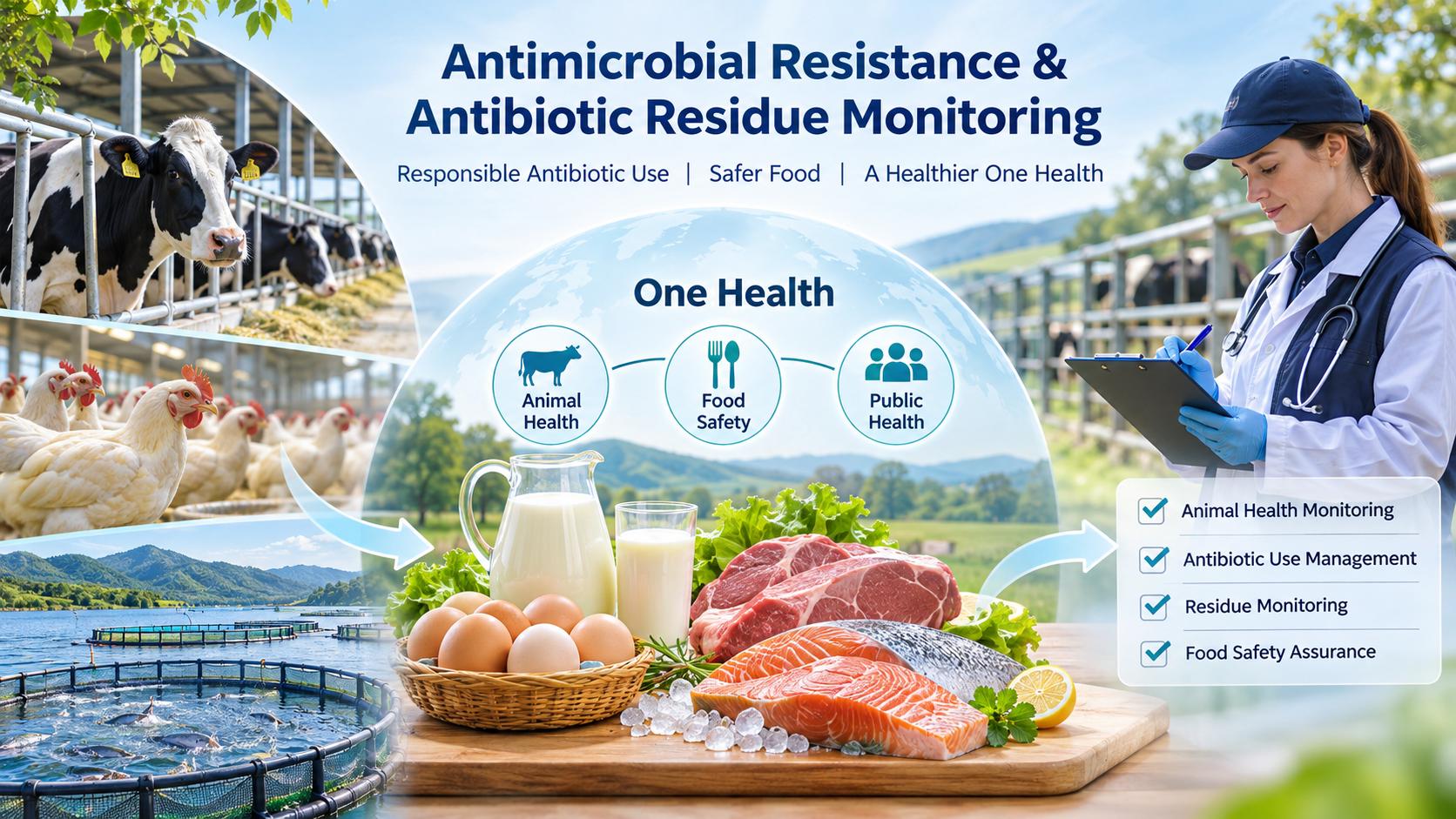
Understanding the Connection Between Antibiotics and Food Safety
Antibiotics play an important role in veterinary medicine, helping prevent and treat bacterial infections in food-producing animals when used appropriately.
However, inappropriate or excessive use can contribute to the development and spread of antimicrobial-resistant bacteria. These bacteria may move between animals, humans and the environment through different transmission pathways, including the food chain.
At the same time, improper antibiotic administration and insufficient withdrawal periods can result in veterinary drug residues remaining in animal-derived foods such as milk, meat and eggs.
Although antimicrobial resistance and antibiotic residues are two different food safety concerns, both highlight the importance of responsible antimicrobial use and effective monitoring.
Why Antibiotic Residue Monitoring Matters
Antibiotic residue monitoring is an important part of food quality control and regulatory compliance.
Food producers and processors need to ensure that veterinary drug residues in their products meet the applicable maximum residue limits (MRLs). Regular testing can help identify non-compliant batches, verify supplier quality and reduce the risk of unsafe products entering the market.
Common monitoring targets include antibiotics from several major groups, such as beta-lactams, tetracyclines, sulfonamides, fluoroquinolones and aminoglycosides.
Different food matrices, including raw milk, meat, eggs, honey and seafood, may require different sample preparation procedures and analytical methods.
Combining Responsible Use with Effective Testing
Testing alone cannot prevent antimicrobial resistance. A comprehensive approach requires several coordinated measures:
- · Responsible antibiotic use: Antimicrobials should be administered under appropriate veterinary guidance and in accordance with relevant regulations.
- · Good farm management: Biosecurity, vaccination, hygiene and disease prevention can reduce the need for antimicrobial treatments.
- · Residue monitoring: Regular testing helps verify compliance with veterinary drug residue requirements.
- · AMR surveillance: Monitoring antimicrobial-resistant bacteria provides information about resistance patterns and their potential spread.
It is also important to distinguish residue testing from AMR surveillance. Rapid test strips and ELISA kits can detect selected antibiotic residues, but they do not directly determine whether bacteria are resistant to antibiotics. Microbiological susceptibility testing and other appropriate methods are required for that purpose.
Kwinbon: Supporting Antibiotic Residue Monitoring
Beijing Kwinbon Technology Co., Ltd. specializes in immunodiagnostic technologies and provides food safety testing solutions, including rapid test strips and ELISA kits for veterinary drug residue detection.
Its antibiotic testing portfolio covers multiple target substances and food applications, supporting screening and laboratory quality control in dairy, meat, eggs, honey, seafood and other relevant food matrices.
With convenient rapid screening options and laboratory-based ELISA solutions, Kwinbon supports food manufacturers, laboratories and inspection organizations in monitoring antibiotic residues and improving routine quality control.
Taking Action for a Safer Food Future
Antimicrobial resistance cannot be addressed by one industry or organization alone. It requires cooperation among farmers, veterinarians, food producers, laboratories, regulators and consumers.
As the global food industry continues to strengthen its approach to responsible antimicrobial use, reliable residue monitoring and effective surveillance will remain important components of food safety management.
Through appropriate testing technologies and continuous innovation, Kwinbon is committed to supporting global partners in building safer food production systems and a more sustainable food future.
Post time: Nov-20-2026