

Food safety is often discussed in terms of pathogens, residues and chemical contaminants. Yet another question is becoming increasingly important across global supply chains: is the product truly what its label claims?
Substitution, dilution, undeclared ingredients, misleading composition and falsified documentation can all weaken traceability and regulatory compliance. Not every authenticity problem creates an immediate health hazard, but some can become direct safety issues when allergens, prohibited substances or unexpected ingredients are involved. Even when health is not directly affected, authenticity failures can lead to rejected shipments, recalls, financial losses and long-term damage to customer trust.
The European Commission now publishes monthly reports on cross-border agri-food fraud suspicions collected through its Alert and Cooperation Network. Its guidance also emphasizes risk-based official controls and vulnerability assessments by food operators. In the United Kingdom, the Food Standards Agency’s 2026 science priorities include better methods to verify food standards and authenticity, together with onsite diagnostics and stronger data tools for surveillance.
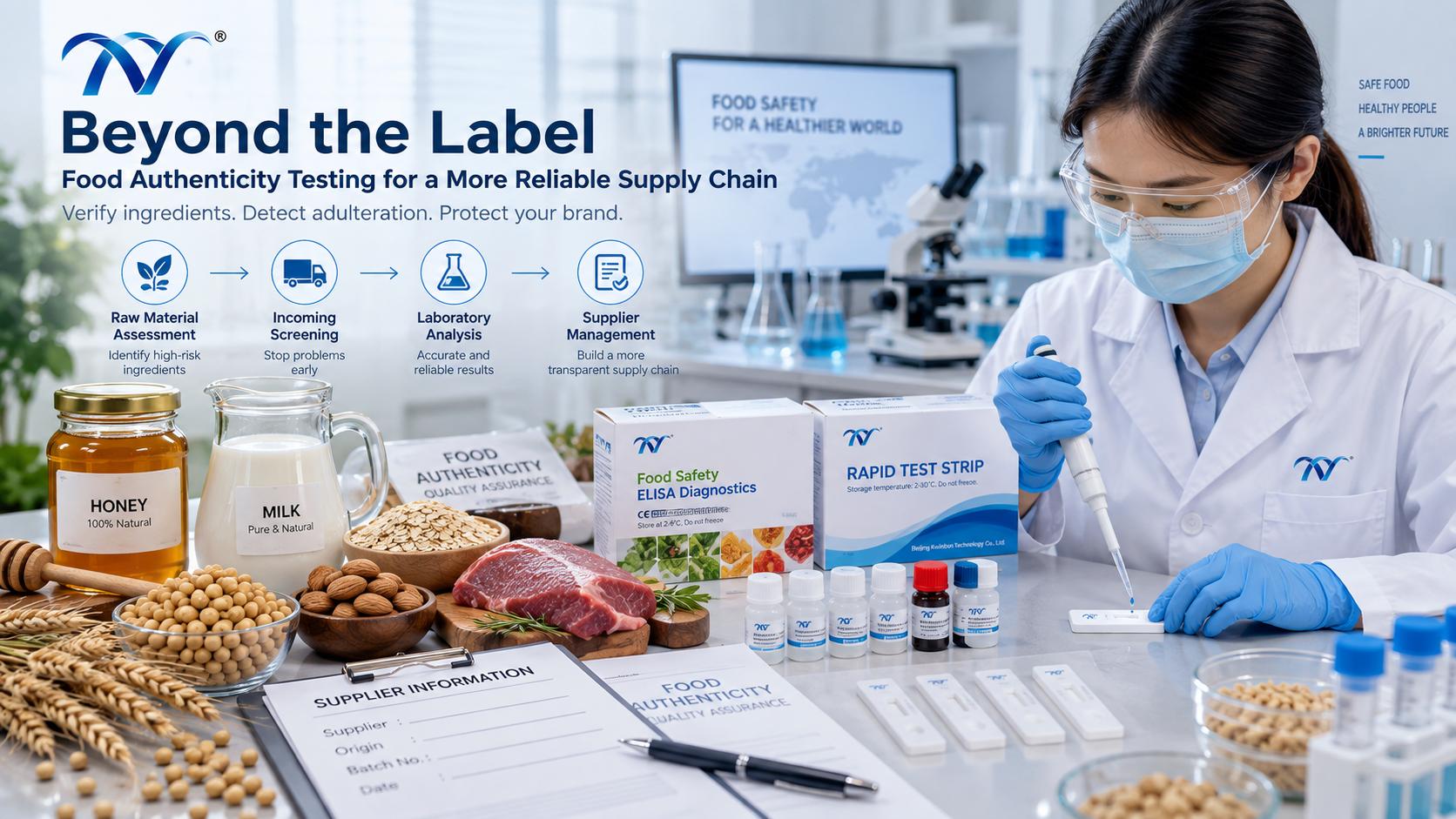
Where Authenticity Risks Begin
Authenticity risks are rarely distributed evenly across a company’s product range. High-value commodities, ingredients with complex processing histories, materials purchased through multiple intermediaries and products exposed to sudden price pressure may require closer attention.
A useful vulnerability assessment considers the economic incentive to adulterate, the complexity of the supply chain, supplier history, ingredient availability and the difficulty of detecting substitution through ordinary visual inspection. The result should be a focused testing plan rather than an attempt to test every sample for every possible problem.
Moving Checks Closer to Incoming Materials
Authenticity control is most effective when it begins before production. Incoming-material screening can help quality teams identify questionable lots before they are mixed with other ingredients or transformed into finished products.
Rapid test strips can support targeted screening for selected residues, illegal additives and adulteration indicators where a validated method is available for the relevant matrix. Their speed makes them useful for routine checks at receiving points, warehouses and production facilities.
For laboratory screening, ELISA kits can provide sensitive analysis and enable multiple samples to be evaluated efficiently. Results that trigger internal action limits should lead to resampling, supplier investigation or confirmation by an appropriate reference method, depending on company policy and regulatory requirements.
Turning Results into Supplier Intelligence
The value of authenticity testing extends beyond a single pass-or-fail decision. Results should be connected with supplier, origin, batch, date and ingredient data. Over time, these records can reveal repeated borderline findings, changing risk patterns or inconsistencies between documentation and analytical results.
Testing therefore becomes part of supplier qualification and purchasing strategy. Reliable suppliers can be rewarded with greater confidence, while higher-risk sources can receive increased sampling, additional documentation checks or corrective-action requirements.
How Kwinbon Supports Targeted Food Testing
Beijing Kwinbon Technology Co., Ltd. develops rapid test strips and ELISA kits for food safety applications covering antibiotics, mycotoxins, pesticides, food additives, hormones used in animal feeding and food adulteration. These solutions can support targeted screening and laboratory quality control when selected and used according to the validated product instructions.
Food authenticity is no longer only a labeling issue. It is an evidence issue. By combining vulnerability assessment, appropriate testing and supplier data, food businesses can move from trusting claims to verifying them—and build stronger confidence throughout the supply chain.
Post time: Sep-15-2026