

Food safety programs have often been measured by the number of samples tested. In 2026, however, the global discussion is shifting toward a more important question: does testing generate the evidence needed for the right decision?
The World Health Organization’s latest estimates indicate that foodborne hazards caused more than 866 million illnesses and 1.52 million deaths in 2021. The 2026 World Food Safety Day theme, “From burden to solutions – safe food everywhere,” emphasizes the importance of using data and science to guide practical action. At the same time, FAO and EFSA have expanded their cooperation in risk assessment, data sharing, early warning and horizon scanning.
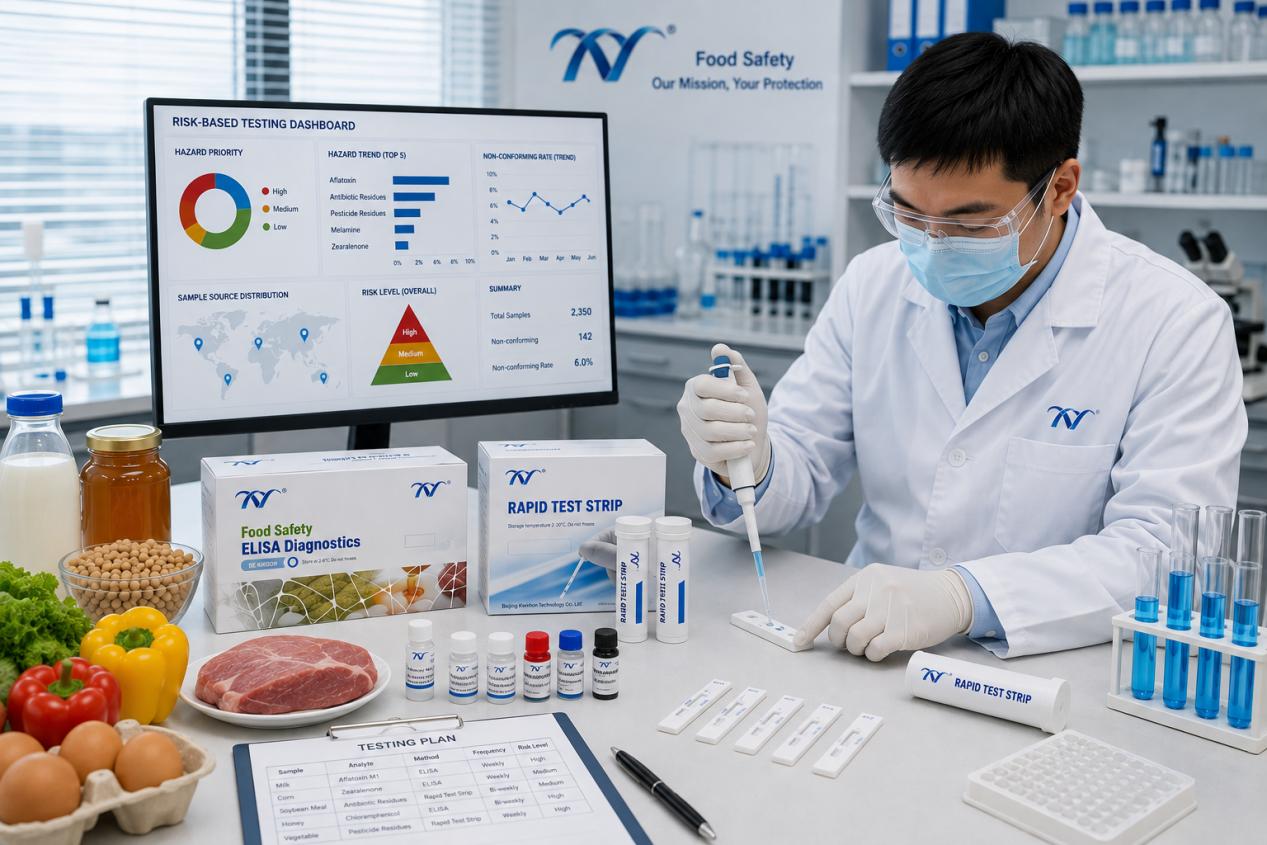
Why More Testing Is Not Always Better
No food business has unlimited time, laboratory capacity or budget. Testing every product for every possible hazard is neither practical nor necessarily effective. A risk-based testing program focuses resources on the hazard–food combinations most likely to affect consumer safety, regulatory compliance or business continuity.
Priorities vary according to the product and operation. A dairy processor may focus on veterinary drug residues and aflatoxin M1, while a cereal or feed company may give greater attention to seasonal mycotoxin risks. Honey, meat, seafood, eggs, fruits and vegetables each present different residue, contaminant and adulteration profiles.
Export destination requirements, supplier history, seasonal conditions and previous non-conformities should also influence which analytes are tested and how frequently samples are collected.
Match the Method to the Control Point
An effective strategy defines not only what to test, but also where, how often and with which method.
At raw-material reception, rapid test strips can support frequent screening before a batch enters production. During processing, targeted checks can help identify deviations while corrective action is still possible. For laboratory batch screening, ELISA kits can provide sensitive quantitative analysis and allow multiple samples to be evaluated efficiently.
These methods should form part of a tiered decision process. Results exceeding an internal action level can trigger a product hold, resampling, supplier investigation or, where regulations require, confirmation using an officially designated reference method.
This approach creates a clear connection between a test result and the operational response that follows.
Turn Test Results into Supplier Intelligence
The long-term value of testing comes from the patterns behind individual results.
Recording data by supplier, origin, season, commodity, analyte and batch can reveal recurring risks that may not be visible from a single certificate of analysis. A supplier with consistently compliant results may justify a different sampling frequency from one with repeated borderline findings.
Seasonal data may also indicate when certain contaminants require greater attention. Testing therefore becomes more than a pass-or-fail activity—it becomes a feedback system supporting supplier qualification, purchasing decisions and preventive quality control.
Supporting Smarter Testing with Flexible Solutions
Beijing Kwinbon Technology Co., Ltd. develops rapid test strips and ELISA kits for food safety applications covering antibiotics, mycotoxins, pesticides, food additives, hormones used in animal feeding and food adulteration. These solutions support multiple sectors, including dairy, honey, eggs, meat and seafood, cereals and feed, and fruits and vegetables.
The next step in food safety is not simply to test more. It is to select the right target, at the right control point, with the right method—and to turn every result into a better decision.
Post time: Aug-21-2026