

Milk safety does not begin at the dairy processing plant. In fact, some potential contamination risks can originate much earlier, in the feed consumed by dairy animals.
Aflatoxin B1 (AFB1), a naturally occurring mycotoxin produced by certain Aspergillus molds, is one of the important contaminants monitored in agricultural commodities and animal feed. When dairy cows consume feed containing AFB1, part of the toxin can be metabolized in the animal's body and transferred into milk as aflatoxin M1 (AFM1). This creates a direct connection between feed quality and the safety of milk and dairy products.
The issue has received renewed international attention. At its 19th session in Cairo, held from October 19 to 23, 2026, the Codex Committee on Contaminants in Foods advanced revisions to the Code of Practice for the Reduction of Aflatoxin B1 in Raw Materials and Supplemental Feedingstuffs for Milk-Producing Animals (CXC 45-1997) for final adoption by the Codex Alimentarius Commission.
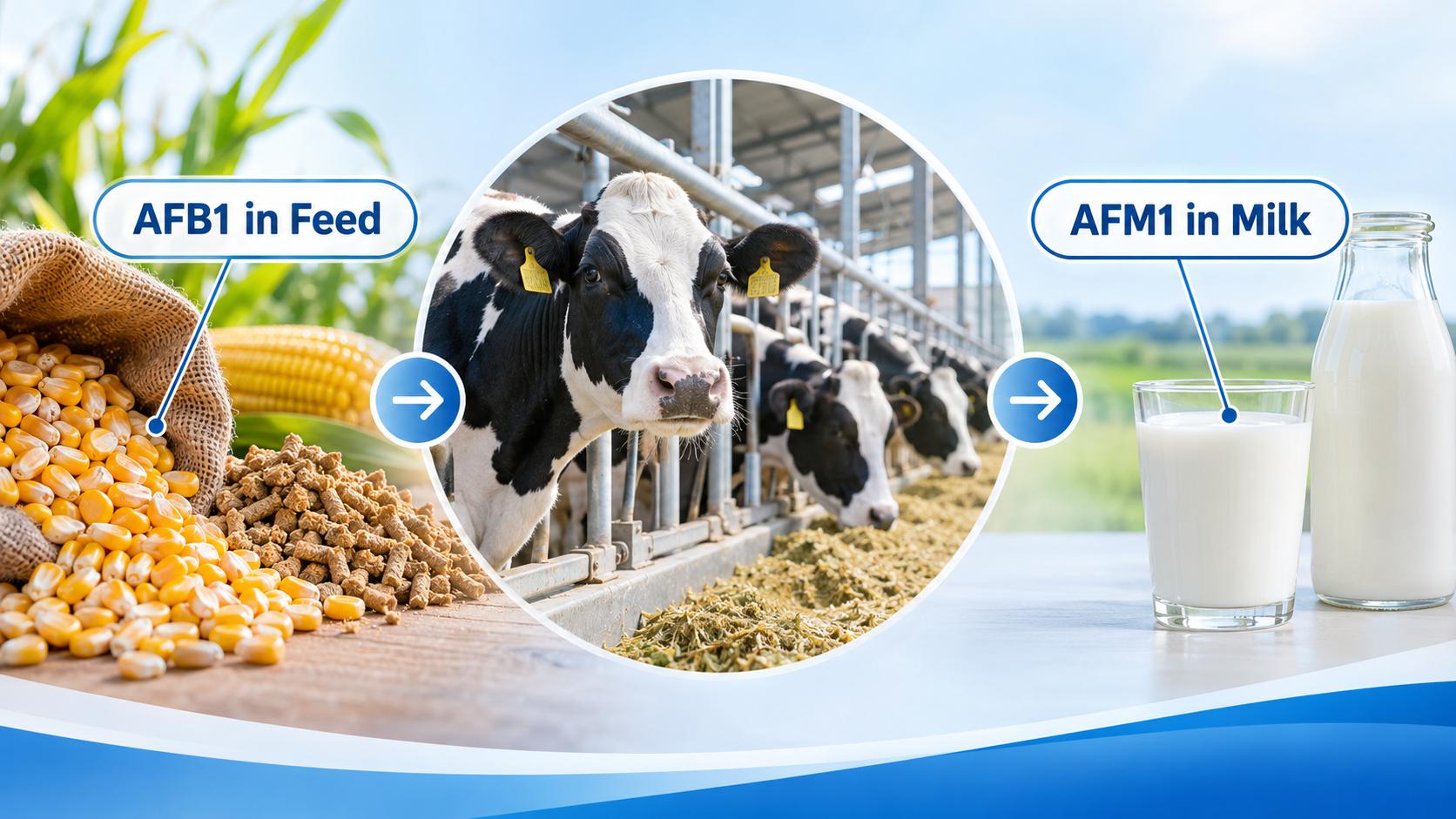
Understanding the Feed-to-Milk Contamination Pathway
Aflatoxin contamination can occur in crops before harvest or during transportation and storage. Corn, peanuts, oilseeds and other agricultural commodities may become susceptible to mold growth under unfavorable environmental conditions, particularly when moisture and temperature are not properly controlled.
When contaminated ingredients are used in dairy feed, AFB1 exposure becomes a potential concern for milk production. Although only a proportion of ingested AFB1 is transferred into milk as AFM1, this pathway makes feed monitoring an important part of dairy safety management.
It also demonstrates why testing only finished milk may not be sufficient to identify the original source of contamination.
Why Feed and Milk Testing Both Matter
An effective monitoring program should cover two connected stages.
Feed testing: Screening raw materials and finished feed for AFB1 helps identify potentially contaminated batches before they are supplied to dairy farms. Particular attention should be given to high-risk ingredients, storage conditions and supplier quality.
Milk testing: Monitoring AFM1 in raw milk and dairy products helps verify product safety and identify potential contamination entering the food supply. Regular testing can also help dairy processors evaluate the effectiveness of their feed management programs.
Together, these two testing stages provide a clearer understanding of contamination risks and support more targeted quality control.
Choosing Suitable Testing Methods
Rapid test strips provide convenient screening options for selected mycotoxins in appropriate feed and food matrices. They can help feed producers, dairy farms and quality control teams obtain preliminary results efficiently.
For laboratory analysis, ELISA kits offer sensitive immunoassay-based detection and can support quantitative analysis of specific mycotoxins. Selecting the correct product for AFB1 in feed or AFM1 in milk is essential, as the target substance and sample preparation requirements are different.
Sampling procedures, matrix compatibility and product instructions should always be considered to ensure reliable results. Where necessary, suspicious findings can be further evaluated using appropriate confirmatory methods.
Kwinbon: Supporting Feed and Dairy Safety
Beijing Kwinbon Technology Co., Ltd. provides food and feed safety testing solutions based on immunodiagnostic technologies, including rapid test strips and ELISA kits.
With testing applications covering mycotoxins, veterinary drug residues and other food safety targets, Kwinbon supports feed manufacturers, dairy producers, laboratories and inspection organizations in establishing practical monitoring programs.
The connection between feed quality and milk safety highlights an important principle: effective food safety management requires attention to every stage of production.
By monitoring aflatoxins in both animal feed and dairy products, businesses can strengthen quality control, improve risk management and contribute to a safer dairy supply chain.
Post time: Nov-06-2026